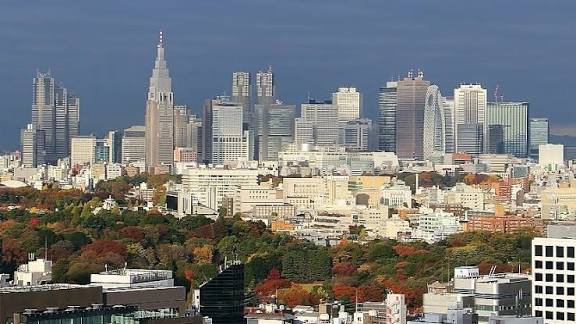
Shinjuku skyscraper skyline and neon cityscape at night in Tokyo
⚡ Urban Energy · Neon Nightscapes · Micro-Bar Culture

Shinjuku Dynamic

A customizable, deeply curated private urban immersion through Tokyo’s hyper-kinetic core—balancing iconic modern skylines with the raw, hidden subcultures found just out of sight.

Gleaming Skylines · Historic Alleys · Cultural Junctions

Shinjuku is Tokyo at full volume — a district of extreme contrasts where gleaming skyscrapers share streets with the narrow red-lit lanes of Golden Gai and Kabukicho. It's exhausting, thrilling, and completely unmissable. By traversing this neighborhood on foot as an independent group, we cut past standard tourist bottlenecks. Terry knows every corner, from the tiny jazz bars that hold ten people to the rooftop views that make the whole city snap into focus.

Major HubShinjuku Station (World's Busiest Train Terminal)
Tour PaceHighly Active · ~12,000+ Steps
Transit TipIC Card (Suica/Pasmo) loaded and ready
Best TimingLate Afternoon transitioning into Neon Nightfall
Vibe ExpansionSeamlessly connects to Harajuku, Shibuya, or Shin-Okubo
Highlights
The Route · High-Rises to Subterranean Corners
Vibrant neon alley in Kabukicho entertainment quadrant
Stop 01 · Entertainment District — Late Afternoon · 04:00 PM
Neon Streets · Urban Nightlife

Kabukicho

歌舞伎町
📍 View on Google Maps ↗

Kabukicho is Tokyo's most concentrated entertainment district — a roughly 500-metre-square grid of streets behind Shinjuku station's east exit that packs more people, light, and noise per square metre than almost anywhere else on earth after dark. The district takes its name from a kabuki theatre that was planned but never built in the postwar redevelopment period, and what grew instead was a dense ecology of hostess bars, host clubs, karaoke buildings, cinemas, pachinko parlours, and restaurants stacked six and seven floors high, all operating simultaneously and entirely without the sense that any single business is aware of the others around it. The famous Kabukicho Ichibangai archway marks the entrance to the main drag, and the experience of walking through it — the scale of the surrounding towers, the competing music from different floors, the density of neon and LED — is one of those genuinely disorienting sensory experiences that Tokyo specialises in and nowhere else quite replicates.

The district has been cleaning up its image in recent years — a large police box now sits at the main intersection, and the most openly criminal enterprises have retreated from street level — but Kabukicho remains unmistakably itself: a place built entirely around the after-dark economy that employs tens of thousands of people and pulls in millions of visitors who come specifically because it is not like anywhere else. Terry navigates it in daylight first, when the architecture and the scale are easier to read, and explains the hostess and host club culture, the role of the yakuza in the postwar development of the district, and the specific geography of what has survived and what has changed since the bubble era. The Robot Restaurant is gone, but the core character of the place — chaotic, commercial, and entirely on its own terms — has not changed at all.

💡 Look skyward between the alley buildings to spot the famous giant Godzilla head looming over the cinema complex. I'll take you to an uncrowded terrace path directly eye-level with the beast.
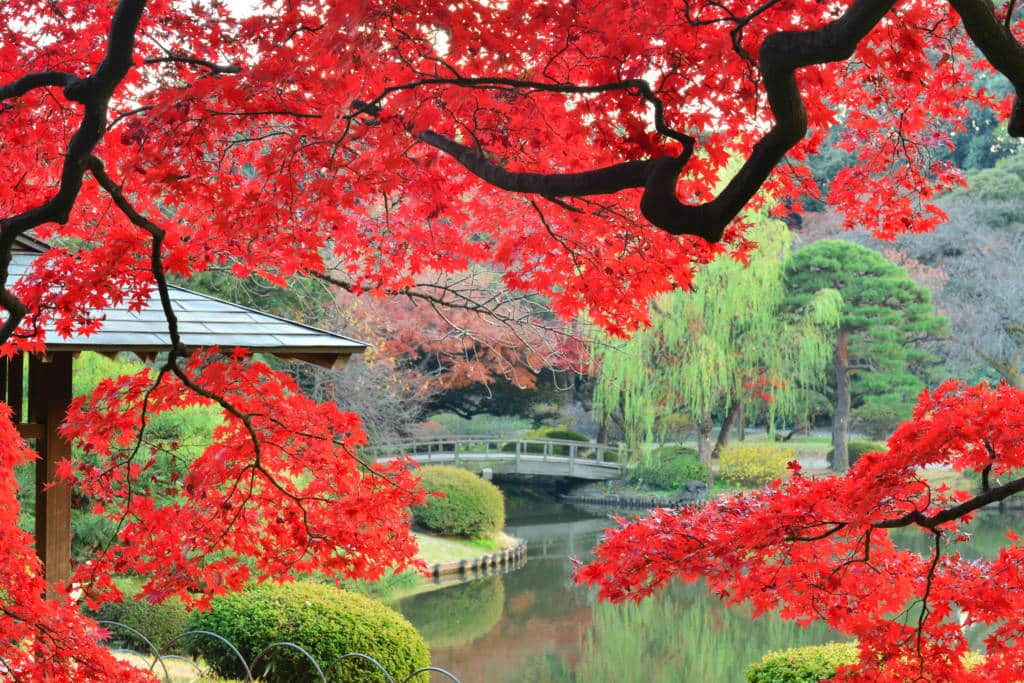
Vivid autumn maple foliage in the traditional Japanese gardens of Shinjuku Gyoen
Stop 02 · Imperial Gardens — Mid-Morning · 11:00 AM
Botanical Escapes · Landscape Design

Shinjuku Gyoen

新宿御苑
📍 View on Google Maps ↗

Shinjuku Gyoen covers 58.3 hectares in the centre of the most densely built district in Tokyo — a fact that becomes almost incomprehensible when you are inside it and the surrounding towers disappear behind the treeline. The garden was originally the private estate of the Naito clan, one of the daimyo families of the Edo period, before being converted into an imperial botanical garden in 1879 and opened to the public after the Second World War. Its design is a deliberate hybrid of three styles arranged in distinct zones: the French formal garden with its geometric parterres and symmetrical planting, the English landscape garden with its sweeping lawn and specimen trees, and the traditional Japanese garden with its shaped pines, stone lanterns, and tea house overlooking a pond. The three styles sit side by side without any attempt to blend or reconcile them, which gives the garden its particular character — a tour of garden design history arranged across a single afternoon walk.

The seasonal rhythm of the garden is worth knowing before you visit. The spring cherry blossom period draws the largest crowds of the year — the combination of over a thousand cherry trees of multiple varieties, a large open lawn for picnicking, and a no-alcohol policy that distinguishes Gyoen from the wilder hanami parties in public parks makes it one of the most civilised blossom-viewing spots in the city. The greenhouse contains a collection of tropical plants and the largest collection of cycads in Japan. In autumn the Japanese garden section turns yellow and gold as the maples and ginkgos come into colour. Terry uses the garden as a deliberate pause point in the middle of a Shinjuku day — a half-hour of open sky and quiet between the commercial intensity of the areas on either side of it.

💡 The frames here are spectacular, capturing pristine traditional reflections with towering skyscrapers framing the sky above. Perfect for high-contrast architectural photography.
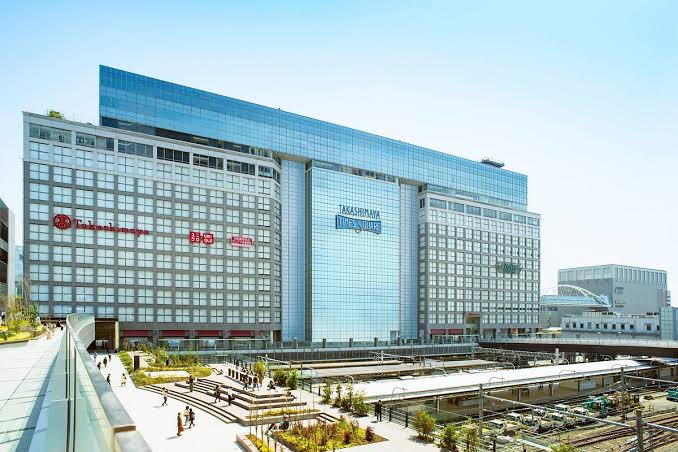
The Takashimaya Times Square shopping and dining complex in Shinjuku
Stop 03 · Retail Monoliths — Early Afternoon · 01:00 PM
Premier Shopping · High-End Depachika

Takashimaya Times Square

タカシマヤタイムズスクエア
📍 View on Google Maps ↗

Takashimaya Times Square is the anchor of Shinjuku's south exit retail zone — a fifteen-floor department store complex that includes Tokyu Hands, a Kinokuniya bookshop, the Takashimaya department store itself, and a restaurant floor at the top occupied by branches of some of Japan's most celebrated kitchens. It is, by almost any measure, one of the largest and most comprehensively stocked retail buildings in the world, and the scale of it — the number of floors, the range of goods, the precision of the presentation — tells you something about the Japanese approach to retail that no other shopping experience quite communicates. The basement food halls are the most immediately compelling section for visitors: two floors of food, arranged by category, where every product is presented with the same level of care and packaging craft as the luxury goods upstairs. Wagashi confectionery shops, specialist senbei sellers, bento boxes assembled with visible technical pride, prepared foods from some of the city's best restaurants sold by the portion — it is entirely possible to assemble a meal here that would embarrass most restaurant kitchens.

The depachika tradition — the department store basement food hall — developed in Japan in the 1930s and reached its current form in the postwar period as the major department store groups competed to attract the most prestigious food producers to their basements. The logic is straightforward: if the food hall is exceptional enough, it draws visitors who then circulate upward through the rest of the store. Takashimaya's basement is consistently ranked among the best in Tokyo, and the concentration of quality in a relatively small area makes it one of the most efficient food-browsing experiences in the city. Terry moves through it by product category, explaining what to look for in each section and which shops are producing at a level worth buying from.

💡 The complex features open-air upper terrace walkways that offer unique bird's-eye perspectives over the complex train tracks below, a dream spot for train-spotting enthusiasts.
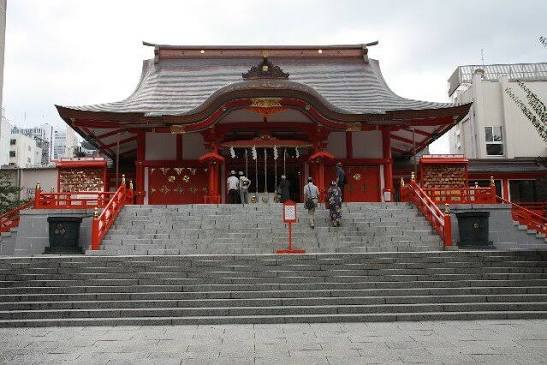
The vermillion torii gates and shrine buildings of Hanazono Shrine tucked beside Shinjuku's nightlife district
Stop 04 · Sacred Spaces — Late Afternoon · 04:00 PM
Shinto Sanctuaries · Quiet Enclaves

Hanazono Shrine

花園神社
📍 View on Google Maps ↗

Hanazono Shrine sits on a small plot of land a few minutes' walk from the east exit of Shinjuku station, surrounded on all sides by the entertainment and commercial buildings of Kabukicho and the shopping streets of east Shinjuku, and the transition from the surrounding streets into its compound is one of the more abrupt contrasts the city offers. The shrine's origins are difficult to date precisely — records suggest a foundation sometime in the mid-Edo period, but the exact date is unclear, and the shrine itself has been rebuilt multiple times. What is certain is that it has been in continuous use on this site while the neighbourhood around it transformed from a rural area on the edge of the shogun's capital into the most commercially intensive district in the world's largest city. The main deities enshrined here — Inari, associated with rice, foxes, industry, and worldly success — made Hanazono a natural object of veneration for the merchants, entertainers, and business owners who populated this district, and the number of votive offerings and the steady flow of visitors making business-related prayers reflects a congregation that takes its relationship with the shrine seriously.

The shrine compound contains several separate structures: the main hall, a secondary Inari shrine with a small row of vermilion torii gates, a large stone fox figure of the kind associated with Inari worship throughout Japan, and the facilities for the nightly flea market that operates on the shrine grounds from sunset and is one of the best antique and vintage markets in central Tokyo. The combination of a working religious site, a nightly market, and location in the middle of Kabukicho gives Hanazono a layered character that makes it one of the more interesting shrines in the city despite its modest size. Terry knows the history of the shrine and its relationship with the entertainment district that surrounds it — a relationship that has shaped both the shrine's character and the district's self-understanding for generations.

💡 Walking through its peaceful courtyard path provides a wonderful palette cleanser and atmospheric twilight transition before navigating back out to the neon avenues.

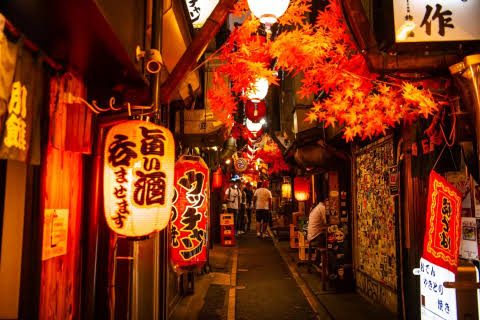
Narrow lantern-lit alleyways of tiny bars in Shinjuku's historic Golden Gai district
Stop 05 · Historic Alleys — Evening · 07:30 PM
Micro-Bars · Retro Architecture

Golden Gai

新宿ゴールデン街
📍 View on Google Maps ↗

Golden Gai occupies a patch of land barely 100 by 50 metres — six narrow alleys containing around 200 bars, most of them capable of seating between five and ten people — that has survived every attempt to redevelop it since the 1960s and has become, in its survival, one of the most written-about small drinking districts in the world. The buildings are two-storey wooden structures from the immediate postwar period, when this area was part of the black market network that kept Tokyo fed and supplied in the years of scarcity. As the black market faded, the buildings became bars, and the bars attracted a specific clientele: writers, artists, filmmakers, musicians, and the kind of professional drinker who prefers a room the size of a wardrobe to a comfortable venue with multiple exits. The character of each bar is set entirely by its owner, some of whom have been running the same room for thirty or forty years, and the range — jazz bars, noise music bars, bars themed around specific sports teams or literary movements, bars with no theme except the personality of the person behind the counter — reflects several decades of accumulation by people who had strong opinions about exactly what their bar would be.

The district nearly disappeared twice — once in the 1980s when Shinjuku ward attempted a compulsory purchase for redevelopment, and again in the 1990s when a series of arson attacks destroyed several buildings. Both times the remaining owners rebuilt and continued. Today Golden Gai is on most visitors' lists, which has changed its character somewhat — cover charges now appear on English signs outside some bars, and the clientele is more international than it was — but the physical fabric of the place, the extraordinary intimacy of the bars themselves, and the sense of having stepped into a Tokyo that the rest of the city has largely demolished remain entirely intact. Terry knows which bars to try and how to navigate the entrance protocols, which vary considerably from one room to the next.

💡 Many doors hide steep stairways to ten-seat rooms; Terry knows exactly which hidden corners are warmly welcoming to international travelers without local-only custom policies.
The Custom Walking Methodology

This is not a fixed commercial route. Shinjuku’s real magic relies entirely on your willingness to explore its intricate verticality—moving from historic basements to glowing rooftops.

We move dynamically based on your physical comfort, curiosity, and tastes. If your goal is deep vintage clothing hunting, hidden photography alleys, or discovering third-wave sake cellars, the path bends on the fly to fulfill those needs.

Daylight Shopping vs. Nightlife Transitions

Shinjuku completely changes its persona depending on the hour. A morning route leans heavily into expansive imperial garden design, high-end retail architecture, and quiet shrines.

Prefer an evening atmosphere? We can orient the entire tour toward a late-afternoon start. This format highlights glowing neon street photography, panoramic twilight viewpoints, and a deeper dive into hidden izakayas and vibrant standing bar subcultures.

The Custom Private Advantage

Every Shinjuku tour is built entirely around what you want to get out of it. Obsessed with vintage fashion? Terry knows the hidden floors other guides walk past. More interested in the history behind the neon? The pace slows and the stories deepen. You set the agenda — the neighbourhood delivers.

All-Inclusive Day Rates

One flat price covers everything — Terry's guiding, Shinjuku Gyoen entry, department store food hall lunch, Golden Gai cover charges, up to two drinks per person, and all subway transit. Terry handles every bill so you never break the flow of the day.

Solo

1 Guest
¥48,000 total
Full 8-hour private day
All transit, admissions & drinks included

Couple

2 Guests
¥61,000 total
¥30,500 per person
All transit, admissions & drinks included

Small Group

3 — 4 Guests
¥72,000 total
From ¥18,000 per person
All transit, admissions & drinks included

Group

5 — 6 Guests
¥85,000 total
From ¥14,167 per person
All transit, admissions & drinks included

What's included in your flat rate

  • 8 hours of private guiding & nightlife cultural commentary
  • Shinjuku Gyoen National Garden entry (¥500/person)
  • Premium department store food hall lunch
  • Golden Gai cover charges (otoshi) at micro-bars
  • Up to 2 local drinks per person at Golden Gai
  • All local subway & train transit during the tour
  • Terry opens Golden Gai doors — no rejection policy
  • Terry's personal transit, admissions & drinks included

Shinjuku involves significant walking, multi-story stairs & tight alleyways. Supportive footwear highly recommended.

* No hidden costs on the day — everything is covered in your flat rate above.

What's Included
  • 8 hours of private guiding, urban navigation & nightlife cultural commentary with Terry
  • Shinjuku Gyoen National Garden entry, department store food hall lunch & Golden Gai bar crawl
  • All Golden Gai cover charges (otoshi) and up to 2 drinks per person at the micro-bars
  • All subway and train transit during the tour
  • Terry opens Golden Gai doors — zero risk of rejection or awkward entry
Good to Know

Everything is covered in your flat rate — no out-of-pocket expenses on the day. Terry pays cover charges and bar tabs discreetly so you never break the atmosphere.

Shinjuku involves significant walking, multi-story stairs, and tight alleyways — supportive footwear is essential.

Connects easily with Harajuku, Shin-Okubo Koreatown, or Shibuya for a custom extended loop — ask Terry about combining districts.

Ready to book a tour of Shinjuku?

Check Terry's calendar availability and submit your tour booking request instantly.